Why Node.js is Perfect for Building Fast Web Applications
Learn why Node.js feels fast

When developers talk about building "fast" backend servers, they aren't usually talking about raw CPU calculation speed. They are talking about efficiency—how well a server can juggle thousands of user requests at the exact same time without slowing down, crashing, or running out of memory.
Since its release in 2009, Node.js has become the gold standard for building high-speed, scalable web applications. But what is the secret sauce? How can a language originally design for simple browser animations handle millions of simultaneous database queries?
To understand why Node.js is so fast, we need to look at its underlying architecture: non-blocking I/O, the Event Loop, and the Single-Threaded Model.
Blocking vs. non-blocking I/O (The Restaurant Analogy)
To understand Node.js, you first need to understand how traditional servers (like early PHP, Java, or Ruby architectures) worked.
The Traditional Server (Blocking)
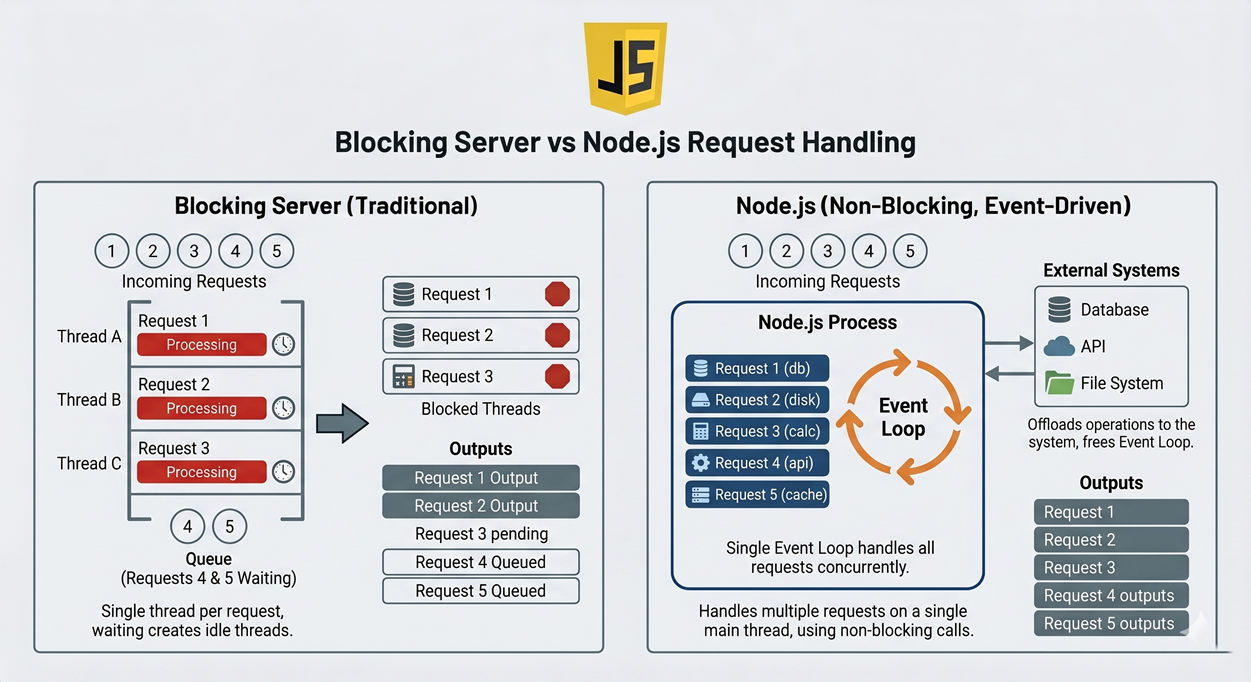
Imagine a restaurant that uses a Thread-Per-Request model. Every time a customer walks in, the manager hires a brand-new waiter (a memory thread) exclusively for that customer.
Customer 1 orders a steak.
Waiter 1 goes to the kitchen and tells the chef.
Waiter 1 stands completely still and waits 20 minutes for the steak to cook. (This is Blocking I/O).
If 1,000 customers walk in, the restaurant must hire 1,000 waiters. Eventually, the restaurant runs out of space (server memory) and crashes.
The Node.js Server (Non-Blocking)
Now, imagine a Node.js restaurant. It only has ONE highly efficient waiter.
The waiter takes Customer 1's order for a steak and hands it to the kitchen.
Instead of waiting, the waiter instantly turns around and takes Customer 2's order.
The waiter continuously takes orders and hands them to the kitchen.
When Customer 1's steak is finally ready, the kitchen rings a bell (an Event). The waiter walks over, picks up the steak, and serves it.
Because the waiter never stops moving, they can handle 1,000 customers all by themselves without consuming extra resources. This is Non-Blocking I/O.
The Single-Threaded Event-Driven Architecture
Node.js runs on a Single-Threaded Model. It processes all JavaScript code on one main thread.
Wait, if there is only one thread, how does it do multiple things at once? The answer lies in the Event Loop.
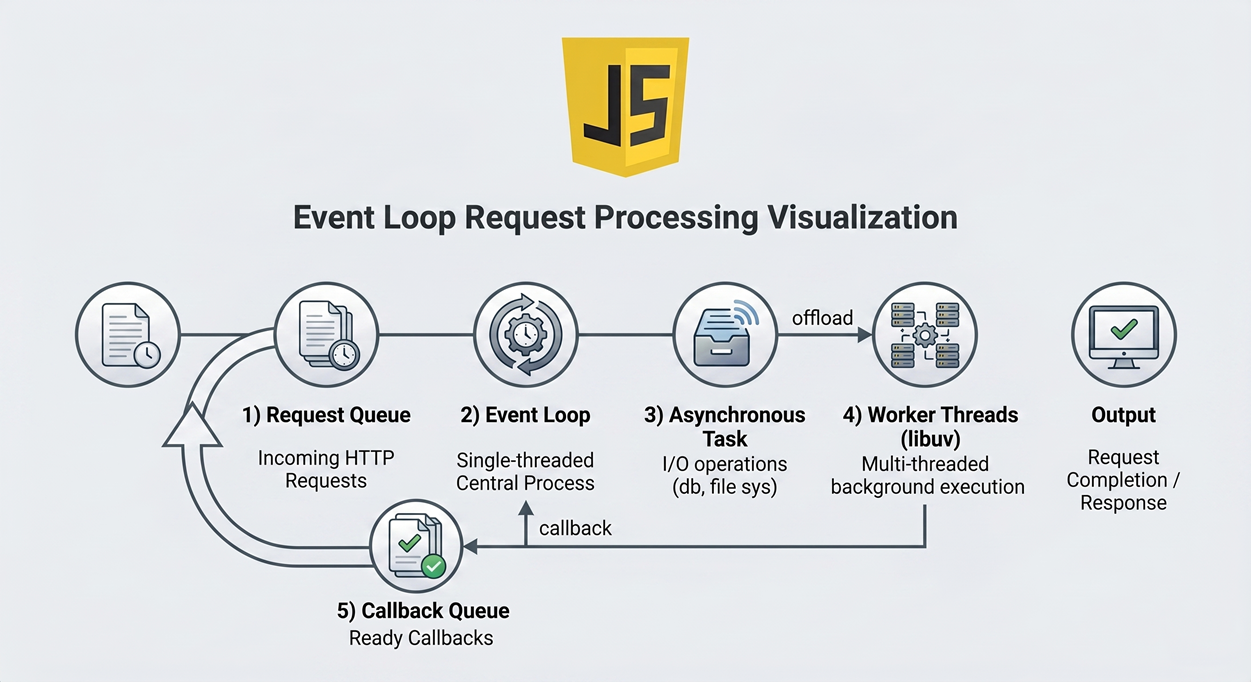
When a request comes in that takes time (like fetching a massive user list from a database), Node.js doesn't do the heavy lifting itself. It acts as an air traffic controller. It delegates the database task to the background (to C++ and the Operating System), registers a callback function, and goes back to handling new requests.
Once the background task is finished, an "Event" is triggered, and the callback function is pushed into a queue for the main thread to execute. This is what we mean by Event-Driven Architecture.
Concurrency vs. Parallelism (Simplified)
To truly appreciate Node.js, we must distinguish between two computer science concepts:
Parallelism is doing multiple things at the exact same physical time. (Example: You have 4 different chefs cooking 4 different meals on 4 different stoves).
Concurrency is managing multiple things at once by switching between them incredibly fast. (Example: One chef chopping vegetables, checking the oven, and stirring soup simultaneously).
Traditional servers try to achieve speed through Parallelism (spinning up multiple threads). Node.js achieves speed through massive Concurrency. Because context-switching between memory threads is computationally expensive, Node's single-threaded concurrency is often vastly faster and uses significantly less RAM.
What Actually Makes Node.js Fast?
The V8 Engine: Under the hood, Node.js runs on Google Chrome's V8 JavaScript engine. V8 compiles JavaScript directly into raw machine code, making execution blistering fast.
Zero Thread Overhead: Because it doesn't spawn a new memory thread for every user, the server doesn't buckle under the weight of memory consumption during traffic spikes.
JSON Native: Web APIs communicate heavily using JSON. Because Node.js is JavaScript, it parses and interacts with JSON natively without needing translation layers.
Where Node.js performs best
Node.js is not a magical silver bullet. It is a specialized tool.
Where Node.js shines:
I/O Heavy Applications: Apps that constantly read/write to databases or file systems.
Real-Time Applications: Chat apps (WhatsApp), collaborative tools (Google Docs), and multiplayer games.
Streaming Services: Video and audio streaming where data is sent in chunks.
REST APIs: Fast, lightweight backends serving data to Single Page Applications (React/Vue/Angular).
Where Node.js struggles:
- CPU-Heavy Tasks: Video encoding, heavy 3D rendering, or massive AI mathematical calculations. If you give the single thread a math problem that takes 10 seconds to calculate, the entire server is blocked for those 10 seconds. No other users can be served. (For these tasks, languages like Python, C++, or Go are preferred).
Real-world companies using Node.js
You don't have to take my word for it. Look at the tech giants who rebuilt their infrastructure on Node.js to achieve massive speed and cost savings:
Netflix: Migrated their user interface backend to Node.js, reducing their startup times drastically and creating a highly responsive streaming experience.
LinkedIn: Moved their mobile app backend from Ruby on Rails to Node.js. They reduced their required number of servers from 30 down to just 3, while making the app 20x faster.
Uber: Built their massive matching system (drivers to riders) on Node.js because of its ability to process massive amounts of real-time geospatial data concurrently.
PayPal: Switched from Java to Node.js, doubling the number of requests per second they could handle while reducing response time by 35%.
Conclusion
Node.js flipped the traditional server model upside down. By combining Google's ultra-fast V8 engine with a single-threaded, non-blocking, event-driven architecture, it proved that you don't need to throw infinite hardware and memory threads at a server to make it scale.
If you are building modern, data-driven, real-time web applications, Node.js provides the perfect balance of blistering speed, resource efficiency, and developer productivity.


