What is Node.js? JavaScript on the Server Explained
JavaScript on the Server : Explained Simply

For the first 14 years of its life, JavaScript was trapped inside a box. That box was the web browser.
If you were building a website in the early 2000s, you used JavaScript for simple things: showing pop-up alerts, animating a dropdown menu, or validating a form. But if you wanted to save a user's data to a database, read a file, or handle a secure login, JavaScript was powerless. You had to switch to "serious" backend languages like PHP, Java, or Ruby.
Then, in 2009, everything changed. Node.js was born, and JavaScript finally broke out of the browser.
Programming Language vs. Runtime Environment
Before we define Node.js, we must clear up the most common misconception among beginners: Node.js is NOT a programming language, and it is NOT a framework.
JavaScript is the programming language. It is the syntax, the loops, the variables, and the logic.
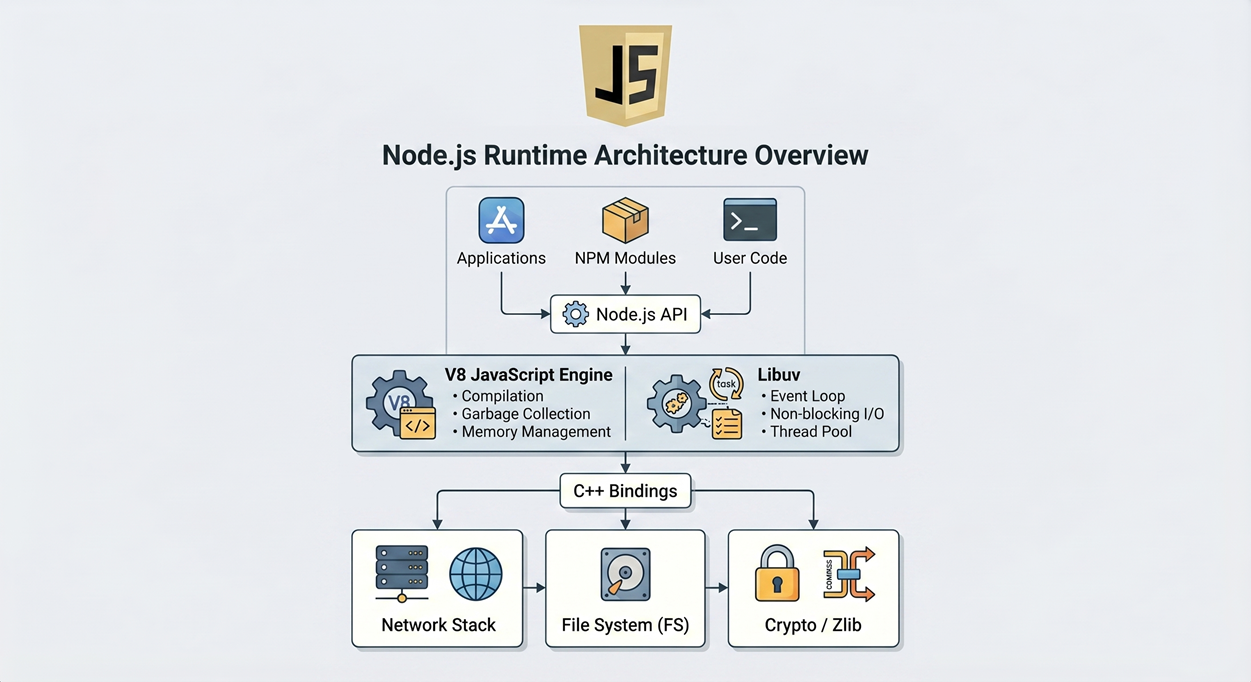
Node.js is a runtime environment. It is the program running on your computer that reads and executes the JavaScript code.
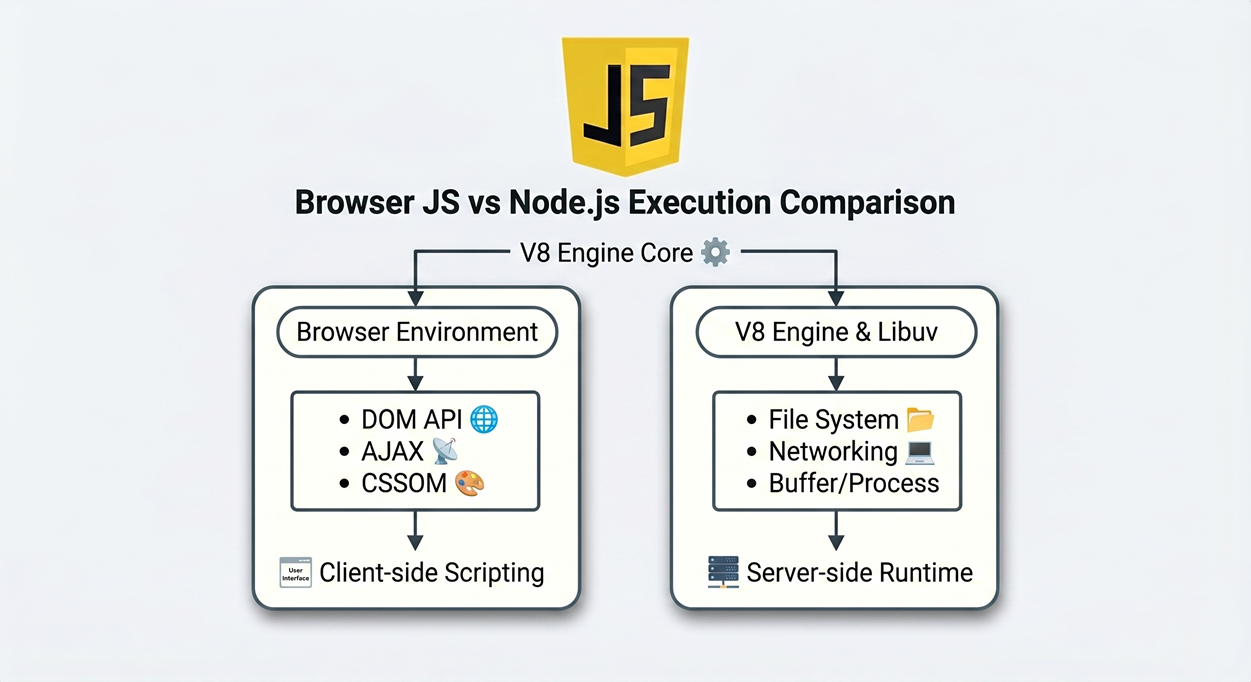
Think of JavaScript as the English language, and the Runtime Environment as a specific country. English spoken in a browser is like English in a coffee shop—you talk about UI colors and button clicks. English spoken in Node.js is like English in a corporate office—you talk about file systems, network requests, and databases.
How Did JavaScript Get on the Server? (The V8 Engine)
Browsers have specialized "engines" built into them to read JavaScript. Google Chrome uses an incredibly fast, open-source engine called V8.
In 2009, a developer named Ryan Dahl had a brilliant idea. He took Google Chrome’s V8 engine, ripped it completely out of the browser, and wrapped it in a C++ program that could run directly on a computer's operating system.
He called this creation Node.js.
Because Node.js runs directly on the OS, it grants JavaScript new superpowers. Instead of just changing the color of a webpage, JavaScript can now create web servers, delete files on a hard drive, and query databases.
What Node.js is?
So, why did developers adopt Node.js when powerful languages like Java and PHP already existed for the server? It comes down to how Node.js handles traffic.
The Traditional Way (Multi-Threaded)
Languages like PHP and Java traditionally use a Thread-Based model. Imagine a restaurant where every time a new customer walks in, the manager hires a brand-new waiter just for them. If 1,000 customers walk in, you need 1,000 waiters. In programming, these "waiters" are memory threads. If a server gets too much traffic, it runs out of memory and crashes. Furthermore, if a waiter asks the kitchen for a steak (a database query), they just stand there doing nothing until the steak is ready. This is called Blocking Code.
The Node.js Way (Event-Driven)
Node.js uses an Event-Driven, Non-Blocking architecture. Instead of hiring 1,000 waiters, Node.js hires one incredibly fast, highly efficient waiter. This waiter takes Customer A's order and hands it to the kitchen. But instead of standing around waiting, the waiter instantly pivots to take Customer B's order. When the kitchen finishes Customer A's food, they ring a bell (an "Event"), and the waiter brings the food to the table.
Because it doesn't waste memory on idle threads, Node.js can handle tens of thousands of concurrent connections on a single server without breaking a sweat!
V8 engine overview (high level only)
You might hear people say "Node.js uses the V8 engine." It sounds complicated. It isn't.
V8 is just the thing that reads your JavaScript code and turns it into something your computer can understand and run. It was built by Google for the Chrome browser. It's fast, very fast.
Ryan Dahl (the creator of Node.js) basically took V8 out of Chrome and said: "What if I let this run on a computer, not just a browser?" That's how Node.js was born.
You don't need to understand V8 deeply. Just know it's the engine under the hood that makes your JavaScript code run fast.
Event-driven architecture idea
Here's something Node.js is good at and it's what makes it special compared to older technologies like PHP.
Imagine a restaurant. In an old-school setup, one waiter is assigned to one table. That waiter takes the order, walks to the kitchen, stands there waiting for the food, then brings it back. While they're waiting, they can't help anyone else. This is called "blocking" — the waiter is blocked, doing nothing, just waiting.
Node.js works differently. It's like a waiter who takes your order, hands it to the kitchen, and immediately goes to take the next table's order. When your food is ready, the kitchen calls out and the waiter picks it up. Nobody is standing around waiting.
This is called the event-driven model. Node.js never just sits and waits. It keeps moving, handling the next thing, and comes back when something is ready.
This makes Node.js extremely fast for things like:
A chat app where many users are talking at the same time
A news feed that loads new posts automatically
An API that thousands of people are calling every second
Real-world use cases of Node.js
Because of its event-driven, non-blocking nature, Node.js is the absolute best choice for applications that require constant, real-time data flow:
Streaming Services: Netflix uses Node.js to handle its massive, high-speed user interface and data streaming.
Real-Time Chat Apps: WhatsApp Web and Slack rely heavily on Node-like environments to send thousands of messages instantly without refreshing the page.
Ride-Sharing Apps: Uber uses Node.js to instantly process thousands of simultaneous driver and rider locations.
Fast REST APIs: It is the industry standard for building fast, lightweight APIs that serve JSON data to frontend applications.
Conclusion
Node.js is not a new language to learn; it is just a new environment where your existing JavaScript skills can thrive. By taking JavaScript out of the browser and supercharging it with the V8 engine and an event-driven architecture, Node.js allows web developers to build lightning-fast, highly scalable backend servers.
Here's everything in one simple summary:
JavaScript used to only work inside browsers
Node.js is a tool that lets JavaScript run on servers (outside the browser)
It uses the V8 engine (from Chrome) to run JavaScript fast
It works differently from PHP — instead of waiting around, it keeps moving and handles many things at once
You can use JavaScript for both the front end and back end with Node.js
It's perfect for building APIs, chat apps, real-time tools, and much more


