How Node.js Handles Multiple Requests with a Single Thread
Node.js Event Loop: How a Single Thread Handles Multiple Requests

When developers first learn about Node.js, they usually encounter a statement that sounds completely contradictory:
"Node.js is single-threaded, yet it can handle tens of thousands of simultaneous user requests faster than traditional multi-threaded servers."
Wait a minute. If a server only has one thread (one "hand" to do work), how can it serve thousands of users at the exact same time without freezing? Shouldn't a heavy database query from User A block User B from even loading the homepage?
To unravel this mystery, we need to understand the difference between threads and processes, the magic of the Event Loop, and the concept of concurrency. Let's dive in!
Single-threaded nature of Node.js
Before we talk about Node.js, let's establish some basic computer science definitions:
A Process is like a factory. It is a program in execution (like your web browser or your Node.js server) that has its own memory space and resources.
A Thread is a worker inside that factory.
Traditional server architectures (like Java or early PHP) use a Multi-Threaded approach. When a new user connects to the server, the process creates a brand new thread (hires a new worker) dedicated entirely to that user. If 1,000 users connect, the server spins up 1,000 threads.
The flaw? Threads consume RAM. If traffic spikes to 10,000 users, the server runs out of memory, the factory overflows, and the application crashes.
Node.js takes a drastically different approach: It runs on a Single Thread. There is only one main worker in the factory.
If you've just started with Node.js, you've probably heard that it's single-threaded. And if you know anything about servers, that probably sounds terrifying. How can one thread possibly handle thousands of simultaneous HTTP connections?
Event loop role in concurrency
To understand how one worker handles thousands of requests, we must understand the difference between Parallelism and Concurrency. Imagine a busy restaurant kitchen.
Parallelism (Traditional Multi-Threaded): The restaurant hires 4 chefs. Chef 1 cooks for Table 1. Chef 2 cooks for Table 2. They work at the exact same time (in parallel). It's fast, but hiring a new chef for every new table is incredibly expensive.
Concurrency (Node.js Single-Threaded): The restaurant hires one Master Chef.
The chef takes an order for a baked potato and puts it in the oven.
Does the chef stand in front of the oven for 45 minutes staring at the potato? No.
The chef turns around, takes an order for a salad, and starts chopping vegetables.
While chopping, the chef puts a steak on the grill.
When the oven timer dings, the chef takes the potato out and serves it. The Master Chef is dealing with multiple tasks concurrently by constantly switching between them, never waiting idly for slow tasks to finish.
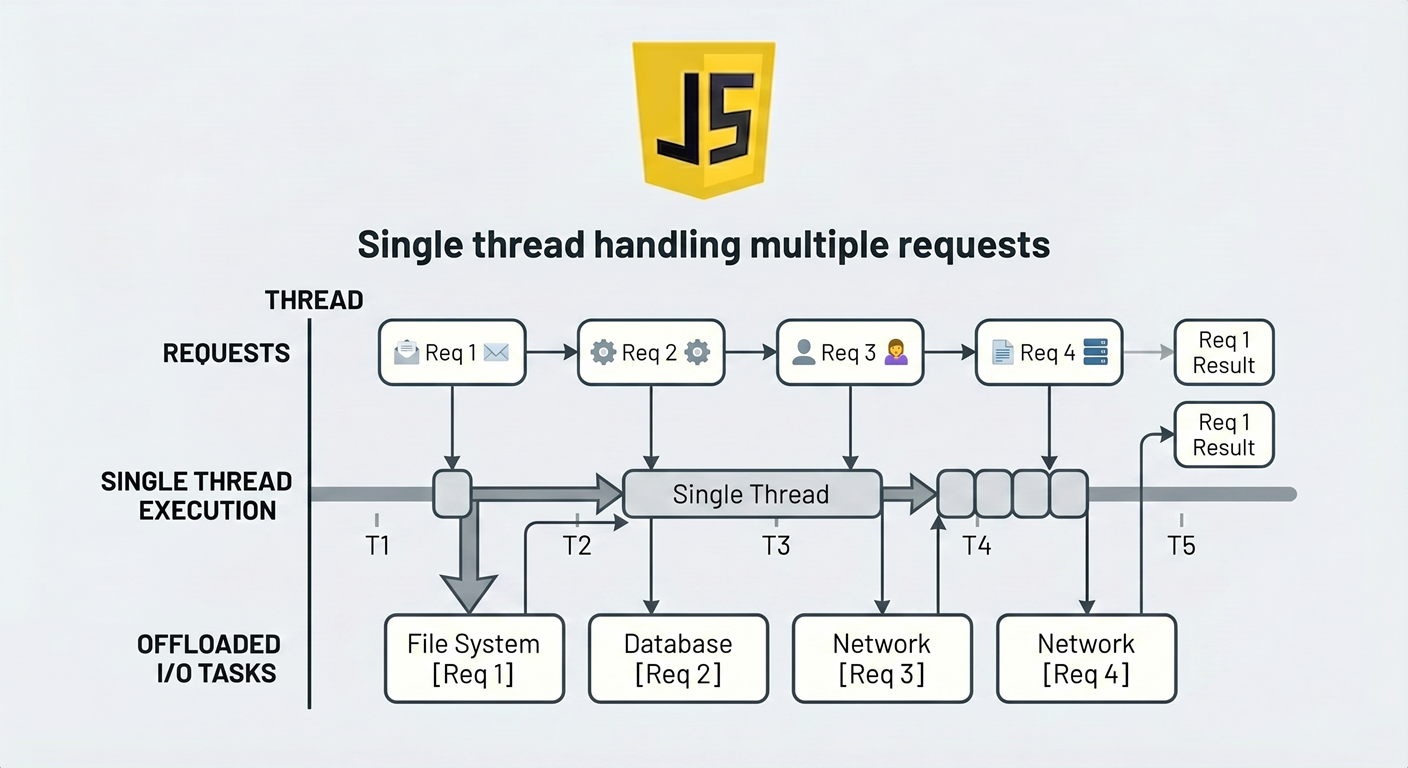
Delegating tasks to background workers
If the Node.js main thread is the Master Chef, who is baking the potato?
While Node.js executes JavaScript on a single thread, the environment it runs in (the C++ runtime and the Operating System) is multi-threaded. Node.js uses a hidden C++ library called libuv which manages a pool of background worker threads.
When a user requests something that takes a long time—like reading a file, sending an email, or querying a database—the main thread does not do the heavy lifting. It delegates the task to the background workers.
Main Thread: "Hey libuv, query the database for User A's profile. Let me know when you have it."
Main Thread: Instantly pivots to serve User B's homepage.
Background Worker: Talks to the database, fetches the data.
Handling multiple client requests
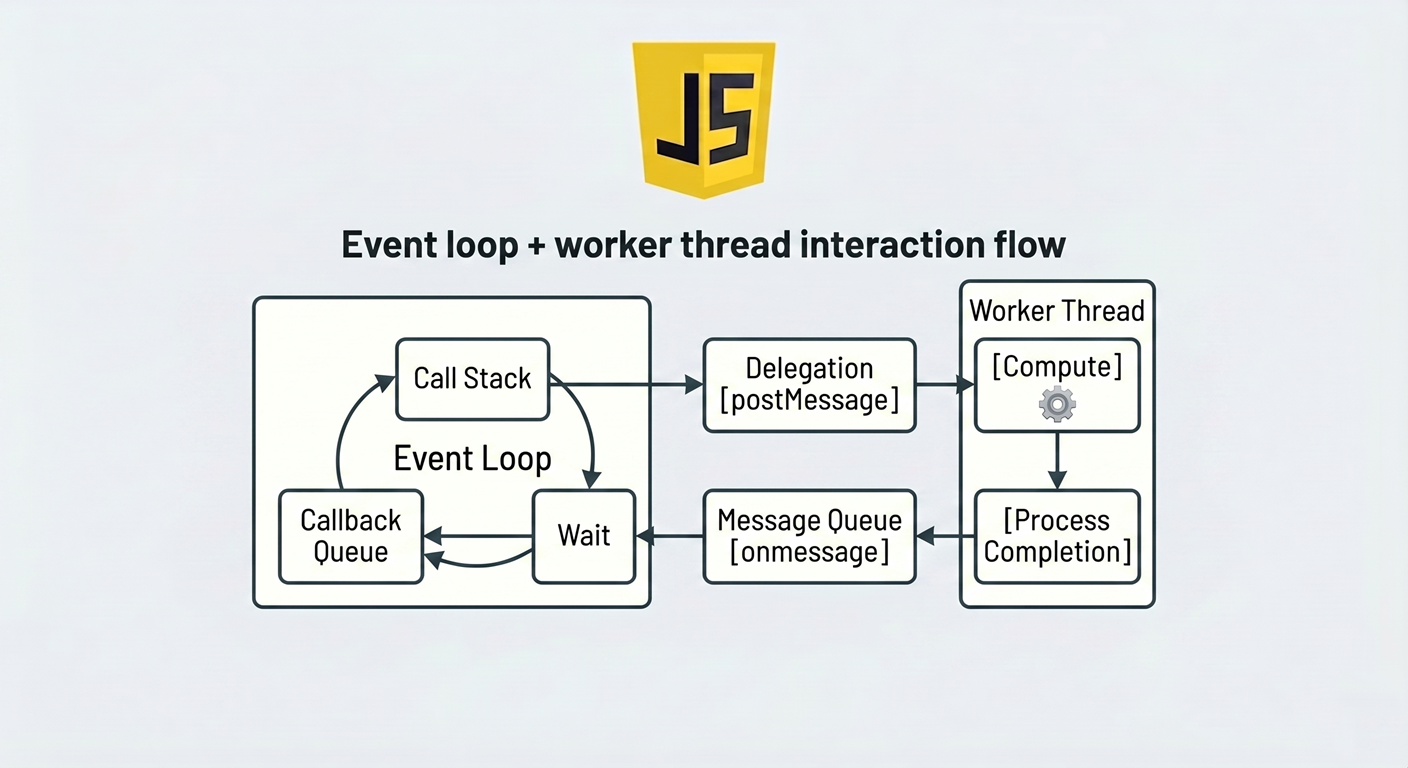
How does the background worker tell the main thread that the data is ready? It uses the Event Loop.
The Event Loop is an infinite loop running inside the main thread. Its entire job is to constantly check: "Are there any finished background tasks that need my attention?"
When a background worker finishes fetching User A's database profile, it places the data—and the associated callback function—into a line called the Task Queue.
The Event Loop grabs that callback from the queue, pulls it onto the main thread, and executes it (e.g., sending the profile data back to the user's browser).
Why Node.js scales well
By combining a single main thread, non-blocking delegation, and the Event Loop, Node.js achieves incredible scalability:
Low Memory Footprint: Because it doesn't spawn a new 2MB memory thread for every single user, a Node server can handle 10,000 concurrent connections using a fraction of the RAM that a traditional Java or PHP server would use.
No Context Switching Cost: Switching between thousands of heavy memory threads exhausts CPU resources. Node.js avoids this by keeping the JavaScript execution on one fast, continuous thread.
Perfect for the Web: 90% of web server tasks are "I/O bound" (Input/Output)—waiting for network requests, database queries, or file reads. Node.js's architecture is tailor-made to handle I/O waiting times flawlessly.
Model | 1,000 concurrent requests | Memory usage | Bottleneck |
Thread-per-request | 1,000 threads spawned | ~500MB–1GB | Thread creation overhead |
Node.js (Event Loop) | 1 thread + Libuv pool | ~50–100MB | CPU-bound operations |
Node.js shines for I/O-bound workloads — REST APIs, real-time chats, streaming, microservices. When a request spends 90% of its time waiting on a database, having a dedicated thread for that waiting is wasteful. The Event Loop eliminates that waste.
Where Node.js Struggles
CPU-heavy tasks (image processing, video encoding, complex computation) block the single thread and starve other requests. For these, Node.js provides Worker Threads (worker_threads module) or you offload to a separate service.
Key Takeaways
Single ThreadYour JS always runs on one thread. No race conditions from shared memory.
Non-Blocking I/OAsync operations are delegated to Libuv and the OS, freeing the thread.
Event LoopThe loop continuously picks up completed callbacks and executes them.
Concurrency ≠ ParallelismNode.js interleaves tasks — it doesn't run them simultaneously.
Scales via EfficiencyLess memory, lower overhead — ideal for I/O-bound high-concurrency apps.
Worker Threads for CPUHeavy computation needs worker_threads to avoid blocking the loop.
Conclusion
Node.js is a masterclass in efficiency. By acting as a highly organized Master Chef, delegating the slow "baking" tasks to background workers, and using the Event Loop to manage the chaos, the single Node.js thread can serve thousands of users at once.
Remember: Node.js is only fast if you don't block the main thread. Keep your heavy math off the main thread, use asynchronous I/O, and let the Event Loop do what it does best!


